
Europe Is Building Its Own Payments System, and the Urgency Is Real
For decades, European policymakers have talked about reducing the continent's dependence on American financial infrastructure. They have convened working groups, published white papers, and issued stern communiqués about the strategic risks of routing trillions of euros through networks headquartered in the United States. Very little changed. Visa and Mastercard continued to process roughly two-thirds of euro-area card transactions, and European consumers continued to tap and swipe without giving the plumbing a second thought.
What is different now is that the plumbing has become a geopolitical weapon, and the people who build it know it. In a Reuters interview on March 26, Martina Weimert, CEO of the European Payments Initiative, confirmed that merchants are signing up for the consortium's digital wallet, Wero, specifically because they fear the Trump administration could restrict European access to U.S. payments systems. Two major retailers cited "international resilience" as their reason for joining. Weimert did not mince words: this was not some remote hypothetical, she said, and disruptions of this kind could materialize quickly.
Introducing Wero
Wero, for those unfamiliar, is a consumer-facing digital wallet that allows instant account-to-account transfers between European bank accounts. It runs on SEPA Instant Credit Transfer rails, bypassing the international card networks entirely and settling payments in seconds rather than days. The name is a portmanteau of "we" and "euro," with a nod to the Italian word for "true." It launched for peer-to-peer payments in Germany in July 2024, followed by France in September and Belgium in November of that year. By early 2026, it had reached roughly 52 million registered users across those three countries, with e-commerce functionality now live in Germany and rolling out across Belgium and France.
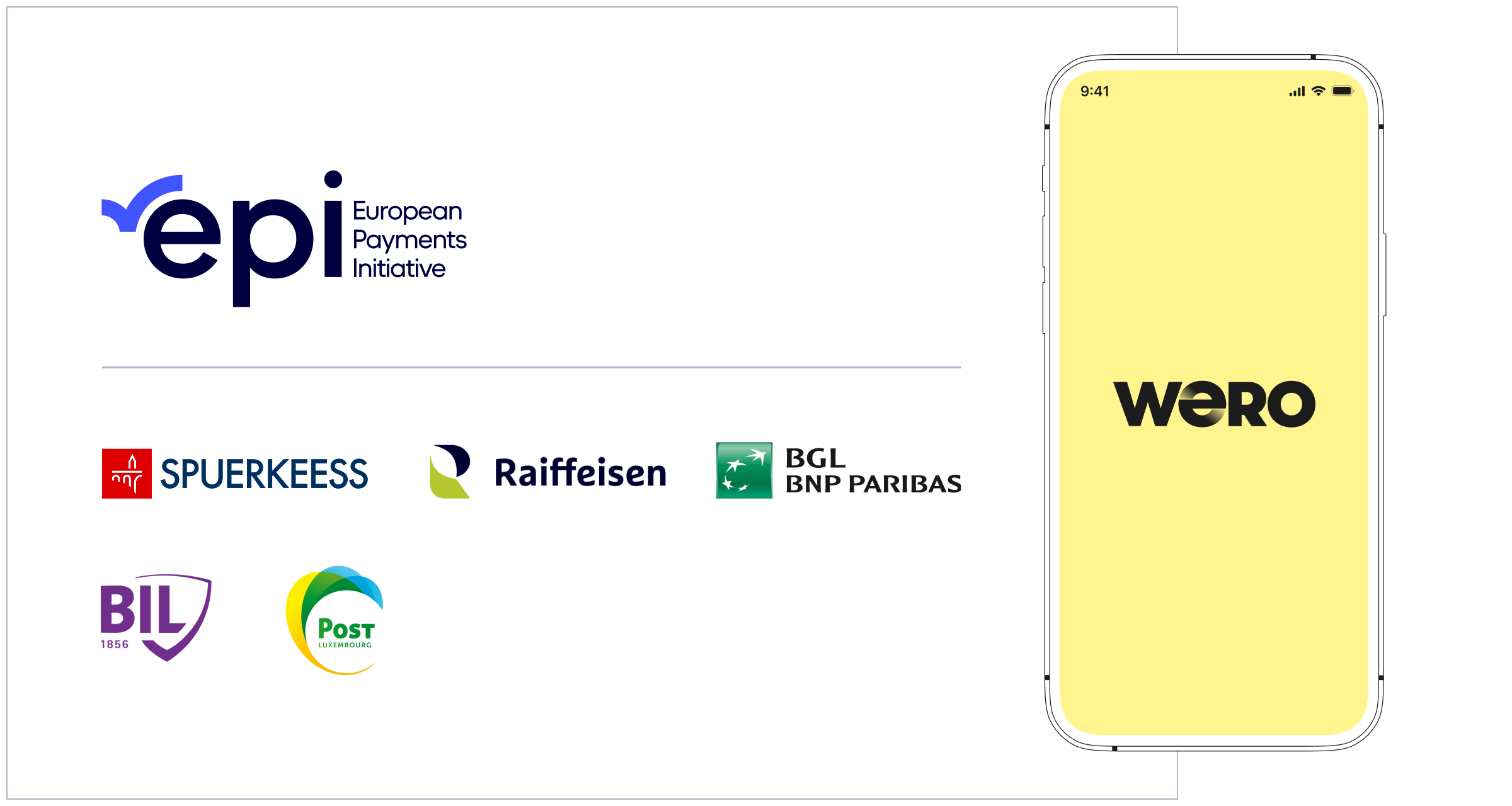
The initiative's origins trace back to July 2020, when 16 major European banks, among them BNP Paribas, Deutsche Bank, and Crédit Agricole, formed a consortium with the ambition of creating a pan-European card scheme to rival Visa and Mastercard directly. That initial vision collapsed under its own weight. By early 2022, roughly 20 banks had withdrawn, including all the Spanish institutions, citing prohibitive costs and execution risks. The consortium pivoted. In 2023, EPI acquired the Dutch payment system iDEAL and Luxembourg's Payconiq, shifting its approach from building a card network to building a wallet-based system on infrastructure that already existed and worked.
That pivot may have saved the project. Rather than competing with card networks on their own terms, Wero offers merchants something structurally different: payments that move directly between bank accounts, without intermediary scheme fees. For retailers, the cost savings are significant, often reducing payment processing expenses by a wide margin compared with card interchange. For consumers, the experience is straightforward, initiated through their existing banking app or a standalone Wero application, authenticated biometrically, and settled instantly.
Progress So Far
The commercial momentum in 2025 and early 2026 has been notable. Nuvei became one of the first major processors to go live with Wero merchant transactions in November 2025. Revolut joined EPI in June 2025, and N26 signed on in December. On March 24, Worldpay, now part of Global Payments, joined as a principal member, promising to roll out Wero acceptance to its merchant base within months. In France, Air France, E.Leclerc, and Orange are among the retailers that have agreed to accept Wero for online purchases. Even the French tax authority has signaled interest in integrating Wero for public-sector payments, a meaningful vote of institutional confidence.
The most consequential development, however, may be the February 2026 memorandum of understanding between EPI and the EuroPA Alliance, a group comprising Italy's Bancomat, Spain's Bizum, Portugal's MB WAY, and the Nordic Vipps MobilePay system. The agreement targets cross-border peer-to-peer interoperability by late 2026, with full commerce and point-of-sale functionality by 2027. If it holds, this would connect Wero to over 120 million additional users across more than a dozen countries, transforming a three-country wallet into something approaching a continental payments rail.
For Europe's banks, the appeal is not hard to understand. For years, they have watched Visa, Mastercard, Apple Pay, and PayPal capture the customer relationship at the point of transaction, extracting fees and, critically, data. Wero allows banks to keep the primary interface in their own mobile apps, preserving customer data and cross-selling opportunities. ING Deutschland alone reported more than 500,000 Wero activations within six months of launch. The more volume that shifts from card networks to account-to-account payments, the more banks recoup in both economics and strategic relevance.
Looking Ahead
For fintechs, the picture is more nuanced but still favorable. Companies like Mollie, N26, and Revolut gain distribution through the banking apps that already reach 75 to 90 percent of retail customers in Wero's core markets. Processors can bundle Wero into unified checkout experiences without the headache of integrating multiple national payment schemes separately. And the sovereignty angle gives European-native fintechs a differentiator that their American competitors cannot easily match, particularly as merchants grow more wary of dependence on Big Tech wallets and U.S. policy volatility.
The elephant in the room remains the digital euro. The European Central Bank advanced the project to its next preparation phase in late 2025, with a possible launch around 2029. Weimert has been diplomatically blunt about the timeline mismatch. She has no quarrel with the digital euro in principle, she has said, but finds it strange that in a moment when European sovereignty is discussed daily, the institutional response is to wait half a decade for a public-sector solution that may or may not work. The ECB, for its part, views Wero as a complementary market-led effort and has suggested that the digital euro's infrastructure could eventually serve as a foundation for private-sector initiatives to build on.
None of this is guaranteed to succeed. Europe's history with pan-continental payment schemes is littered with coordination failures, and the classic chicken-and-egg problem of payments, where merchant acceptance depends on consumer adoption and vice versa, has humbled better-funded efforts. Consumer habit is a formidable barrier: at the physical checkout counter, people reach for the card or phone they have always used, and no amount of geopolitical reasoning changes behavior overnight. Point-of-sale functionality, the real test, is not expected until later in 2026 and into 2027. And bank-led governance, while providing scale and trust, can also mean slower decision-making and internal politics that frustrate the more agile fintechs at the table.
Still, the convergence of commercial traction and geopolitical urgency makes this moment different from previous attempts. Fifty-two million users, a growing roster of processors and merchants, an interoperability agreement spanning thirteen countries, and a political climate that treats payments sovereignty as a matter of national security rather than a regulatory talking point: these are not the ingredients of a white paper. They are the ingredients of infrastructure.
The next twelve months will be decisive. If Wero can convert its peer-to-peer user base into active e-commerce and point-of-sale customers, and if the EuroPA interoperability agreement translates from memorandum to functioning cross-border payments, Europe will have built something it has never managed before: a homegrown payments system with genuine continental reach. If not, the continent will continue routing its financial lifeblood through networks it does not control, hoping that the geopolitical weather stays mild. Given the current forecast, that seems like an increasingly uncomfortable bet.