
Europe's First Instant Payments Report Card
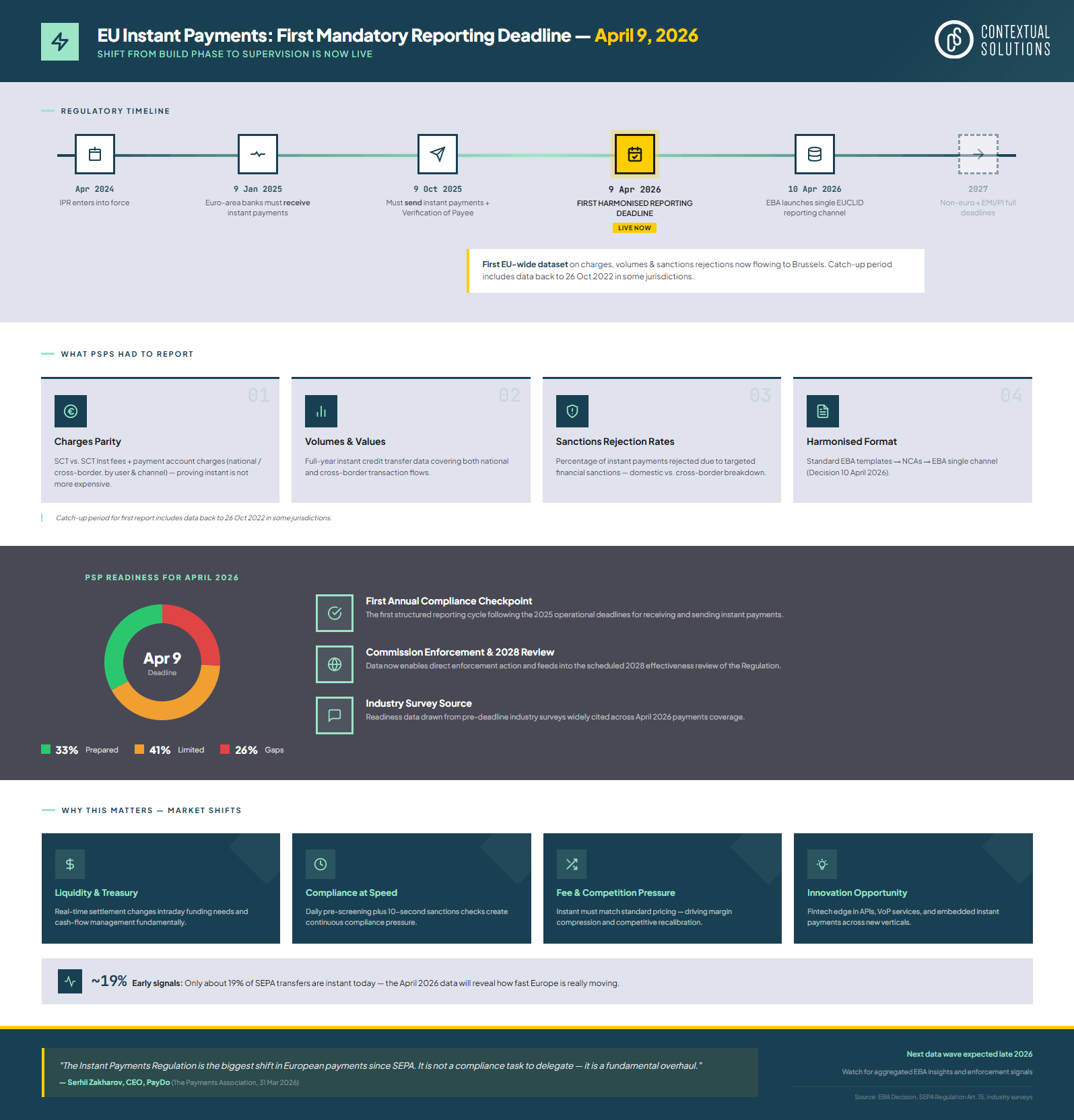
Download the scorecard to view it in full size.
What the April 2026 IPR Filings Reveal About Real-Time Reality
Last Wednesday, April 9, marked a quiet but consequential moment in European financial regulation. Every payment service provider operating in euro credit transfers, from multinational banks to lean fintech e-money institutions, was required to submit its first standardized annual report to national regulators under the EU Instant Payments Regulation. The filing itself was technical, dry, rendered in XBRL-CSV templates. Its implications are anything but.
The IPR, formally Regulation (EU) 2024/886, entered into force in April 2024 with an ambition so sweeping it has been called the most significant overhaul of European payments since SEPA itself. The regulation mandates that all euro credit transfers settle within ten seconds, around the clock, every day of the year, and that instant payments cost consumers no more than standard transfers. Throughout 2025, eurozone banks raced to build or retrofit the infrastructure needed to receive and send those payments. But infrastructure alone was never the endgame. What arrived on April 9 was the accountability layer: a harmonized reporting regime designed to reveal whether this grand experiment in real-time finance is actually working.
What the filings contain
The reports filed last week cover the period from October 26, 2022, when the IPR was first proposed, through the end of 2025. They require every PSP to disclose the fees it charges for standard credit transfers versus instant ones, broken down by national and cross-border transactions, by retail and corporate user types, and by initiation channel. They also require disclosure of how many instant payments were rejected due to sanctions screening. The European Banking Authority designed these templates with a specific enforcement purpose in mind: to ensure that instant payments are not being priced as a premium product, and that the speed of real-time settlement is not generating disproportionate friction in sanctions compliance.
One day after the filing deadline, on April 10, the EBA published a Decision creating a single reporting channel through its EUCLID platform. National competent authorities will now forward all collected data exclusively to the EBA, which will in turn share it with the European Commission. As the EBA stated, the centralized channel is designed to reduce administrative burden on NCAs while ensuring that both the EBA and the Commission receive consistent, high-quality data. By consolidating the pipeline, the EBA is building the foundation for genuine EU-wide supervisory analysis.
An industry caught mid-stride
The trouble is that the industry was not entirely ready for this moment. A survey by Intix, a transaction data management firm, found that only 33 percent of European banks considered themselves fully prepared for the IPR's demands. Another 41 percent reported being ready with significant limitations, while a quarter acknowledged they were not ready at all.
Yoann Vandendriessche, Intix's Chief Product Officer, was frank about the challenge:
"Banks that are lagging must move quickly to close these gaps. Investment in advanced data management and compliance technologies is essential."
The readiness gap is partly why last week's deadline exists at all, a year later than originally planned. The EBA had initially set a reporting date of April 2025 but postponed it by twelve months after a public consultation revealed that PSPs needed more time to align on definitions, adopt templates, and implement the reporting systems capable of delivering accurate, comparable data. Until the postponed deadline, national regulators were instructed not to penalize providers for failing to submit data and to discourage any ad hoc, unharmonized reporting that might muddy the eventual picture.
That reprieve has now expired. The data is in, or should be, and what happens next will determine whether the IPR transitions from policy aspiration to measurable market reality.
The pricing question at the heart of the data
The core question the data is meant to answer is deceptively simple: are instant payments actually cheaper, or at least no more expensive, than regular transfers? The regulation explicitly prohibits surcharges on instant credit transfers relative to standard ones. If the first round of filings reveals that some providers have been padding fees for real-time service, the Commission and national authorities now have the standardized evidence they need to investigate and, if warranted, to penalize. This is not an abstract enforcement power. The reporting feeds directly into the Commission's planned 2028 effectiveness review of the IPR and its broader digital finance and Capital Markets Union objectives.
Sanctions screening at speed
Equally telling will be the sanctions rejection data. Under the IPR, every instant payment must be screened against updated sanctions lists within the ten-second execution window. For most institutions, that means abandoning traditional batch-based transaction screening in favor of pre-screening customers against daily-updated lists. As KPMG analysis cited in industry guidance has noted:
"The only way to screen instant payments in ten seconds is to pre-screen customers."
The rejection rates reported across the EU will offer the first comprehensive picture of how well institutions have managed this architectural shift, and whether the speed of real-time settlement is creating meaningful trade-offs between velocity and financial security.
A structural advantage for fintechs
For fintech firms and e-money institutions, the stakes are distinctive. Many of these companies were built on real-time infrastructure from the outset and may find themselves at a structural advantage over incumbent banks still migrating away from batch processing and overnight settlement. Serhii Zakharov, CEO of the payments infrastructure provider PayDo, captured the scale of the transition when he wrote for The Payments Association:
"The Instant Payments Regulation is the biggest shift in European payments since SEPA. It is not a compliance task to delegate."
His assessment is bracing: an estimated one in five EMIs may miss the July 2027 deadline for sending instant payments, not for lack of ambition but because they underestimated the infrastructure demands of continuous real-time processing.
The liquidity implications deserve particular attention from treasury professionals. Real-time settlement fundamentally changes intraday funding dynamics. When payments clear in seconds rather than overnight batches, the rhythms of cash management shift accordingly, demanding new tools for liquidity forecasting, new buffers, and potentially new relationships with clearing and settlement infrastructure. For corporate treasurers who have long relied on the predictable cadence of end-of-day settlement, the transition to continuous real-time flows requires rethinking operational assumptions that have held for decades.
A regulatory pile-up
The reporting regime also arrives at a moment of unusual regulatory density in European finance. The IPR intersects with the Digital Operational Resilience Act, which classifies instant payment infrastructure as a critical function subject to stringent incident-reporting obligations. It overlaps with the emerging PSD3 and Payment Services Regulation framework, where political agreement was reached in late 2025 and national transposition is now underway. It connects to MiCA's treatment of stablecoins and e-money tokens, and to the broader open finance data-access agenda. Each of these regulatory threads creates its own compliance demands, but they share a common technological substrate: ISO 20022 messaging, API-based connectivity, and the capacity for real-time data processing. Institutions that have invested in these capabilities for IPR compliance will find themselves better positioned across multiple regulatory fronts. Those that treated instant payments as a siloed compliance exercise may discover that their technical debt compounds quickly.
As SBS Software observed in its analysis of the reporting requirements:
"The new IPR requirements represent more than a compliance hurdle, they signal a fundamental shift in how transparency, accountability and fairness are enforced."
The executive playbook for 2027
What should executives be doing right now? First, auditing the quality of their own submissions. Given the readiness gaps the Intix survey exposed, the first wave of filings will likely contain uneven data. Institutions that identify and correct errors early will be better positioned when the EBA begins publishing aggregated findings, likely in late 2026 after national authorities forward data by October. Second, benchmarking their fee structures and rejection rates against the industry averages that will eventually emerge from this dataset. The IPR's pricing parity requirement is not aspirational; it carries enforcement consequences, and the data to identify outliers now exists. Third, stress-testing their Verification of Payee integrations and sanctions pre-screening architectures, because the operational demands of the next compliance milestones, particularly the January and July 2027 deadlines for non-eurozone and non-bank PSPs, will only intensify.
Visibility before accountability
The April 9 filings do not, on their own, change anything about how money moves in Europe. Payments cleared in ten seconds last Tuesday exactly as they did the Tuesday before. What changed is that regulators can now see the system with a clarity they have never had before: who is charging what, who is rejecting how many transactions, and who is, or is not, making instant payments the accessible default that the regulation demands. That visibility is the precondition for accountability. And accountability, in the end, is what separates a regulation from a wish.