
The digital euro leaves the drawing board
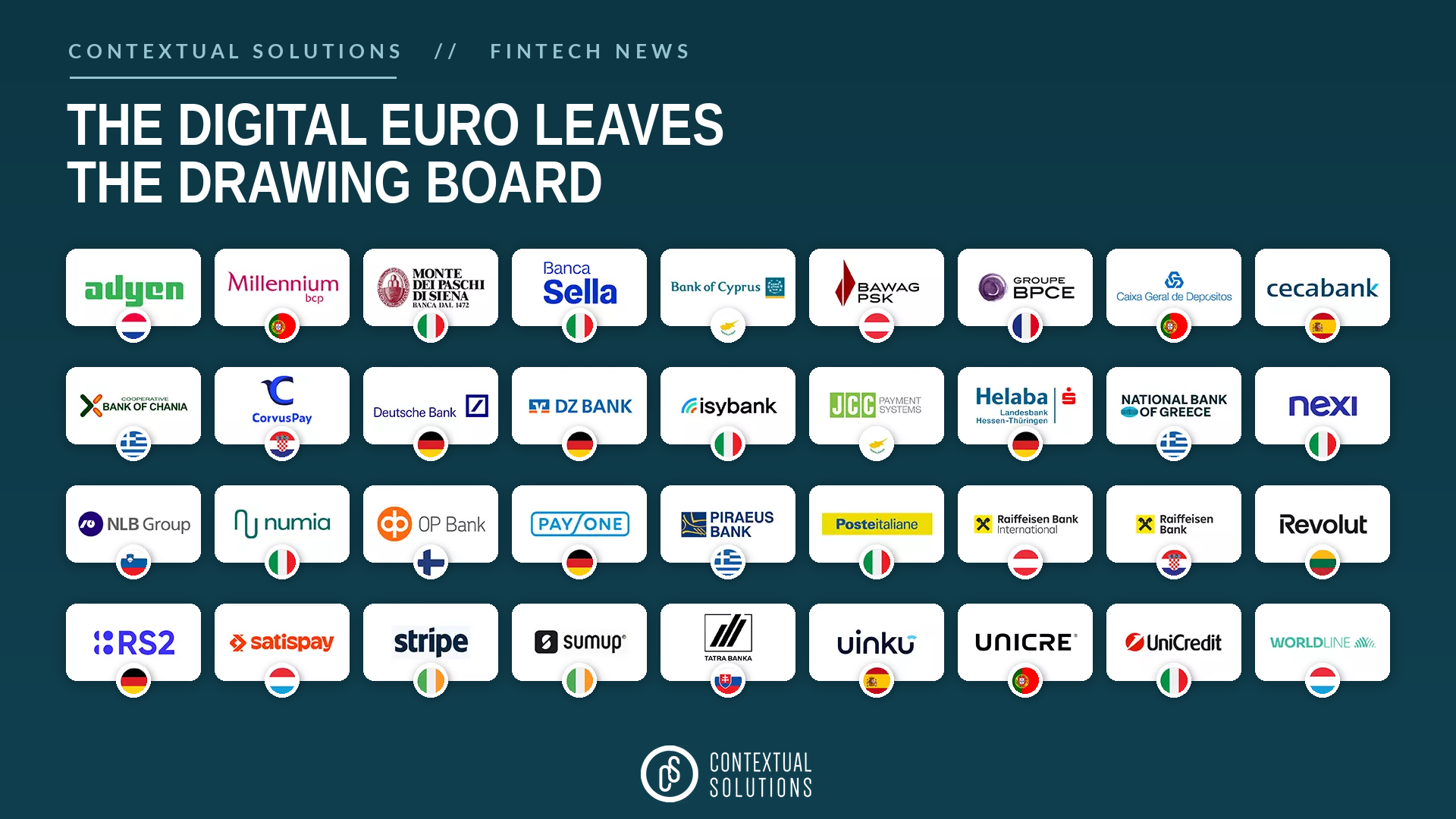
For six years the digital euro has lived mostly in reports, consultations and legislative drafts. On 14 July 2026 that changed, when the European Central Bank named the 36 payment service providers that will help it test a working version of Europe's prospective central bank digital currency. Chosen from more than 50 applicants, the group runs from incumbent lenders to the fintechs that have reshaped European checkout in the past decade. Their selection turns a policy exercise into an operational one, and it sets a clock running toward a possible first issuance around 2029.
A long road to a short list
The case for a public digital currency has been building since the ECB published its foundational report in October 2020. Three forces have pushed the project forward. Cash use has fallen across the euro area. Private digital payments, many of them routed through American card networks or dollar-denominated stablecoins, have filled the gap. And European policymakers have grown uneasy about depending on infrastructure they do not control.
The response has been deliberate. A two-year investigation phase that began in July 2021 found no technical barriers to a digital euro. Work with firms including Amazon, CaixaBank, Worldline and Nexi explored how such a currency might reach users. In June 2023 the European Commission tabled the legislation that would give it legal footing, and that autumn the Governing Council opened a preparation phase covering a scheme rulebook, provider selection and an innovation platform. A call for expressions of interest followed in March 2026, drawing the applications from which the 36 were drawn.
Throughout, the ECB has held to a consistent design. Transactions would be verified without exposing unnecessary personal data. Holdings would be capped to limit the drain on commercial bank deposits, and balances would earn no interest. Distribution would run through regulated intermediaries rather than accounts held directly at the central bank. The currency would work offline, remain free for basic use and sit alongside cash rather than supplant it. The stated aim is a pan-European payment option that keeps public money usable as commerce moves online.
Enter the 36 Banks
The selected providers cover 16 of the 21 euro-area countries and a wide span of business models. Among the incumbents are Deutsche Bank and UniCredit, alongside cooperative and regional lenders such as DZ Bank and Helaba. The digital-first cohort includes Revolut, Stripe, Adyen, SumUp and Satispay, with Worldline representing the infrastructure layer. National champions feature heavily, with eight Italian participants including Intesa Sanpaolo's Isybank, Poste Italiane, Nexi, Banca Monte dei Paschi di Siena, Banca Sella and Numia, and Greek lenders such as Piraeus Bank and the National Bank of Greece also in the mix.
The pilot itself is bounded and practical. It begins in the second half of 2027 and runs for twelve months, hosted by the ECB and 19 national central banks. Bulgaria and Malta sit outside the exercise. Participants will use a beta version of the digital euro that mirrors the draft legislative design in function and technology while carrying no legal-tender status. Providers fall into two roles. Distributing PSPs will set up accounts and enable payments for testers, while acquiring PSPs will handle merchant acceptance, and several firms will do both.
Testing will focus on everyday use. The early users are Eurosystem staff, joined by selected e-commerce sites and physical merchants such as cafeterias and restaurants. Person-to-person payments will be tried online and offline, and person-to-business payments at physical points of sale, in software-based terminals and in mobile and e-commerce settings. The purpose is to validate technical performance, operational processes and user experience under real conditions. No decision to issue has been taken, and none can be until legislation passes and the Governing Council votes.
"The strong market interest in the pilot shows the private sector's readiness to engage actively and quickly advance with the digital euro project to strengthen the European payments landscape. We look forward to deeper engagement as we work with and learn alongside European payment service providers in developing a secure, efficient and inclusive digital euro."
Piero Cipollone, ECB Executive Board member and chair of the High-Level Task Force on a digital euro
What the market wants to learn
For the firms involved, participation buys early sight of technical requirements and competitive positioning. Their public comments share a pragmatic register, treating the pilot as a chance to work out how a public rail would slot into private payment flows.
"This initiative will define how public digital money works in everyday commerce, and what it would take to integrate it into real-world payment experiences. What would it take to integrate the digital euro into existing payment flows? How should it be presented at checkout? What would implementation mean for merchants operationally?"
Stripe struck a similar note, framing success in terms of the demands merchants already place on payment infrastructure.
"Success will depend on building a digital euro that works for the real economy: one that is easy to integrate and provides the security, reliability, and performance businesses expect from today's payment infrastructure."
Revolut, which said it will make its pan-EU banking infrastructure available for technical integration and testing, welcomed the role in comparable terms. The common thread is caution paired with commitment. Design choices still under debate, from holding limits to compensation for intermediaries, will shape whether the finished product is worth building around.
The stakes beyond the pilot
The exercise is the most tangible step yet toward a possible 2029 launch, and it runs in parallel with the politics. The European Parliament advanced its negotiating position in early July, with privacy safeguards, offline capability and merchant acceptance rules among the sticking points. Trilogue talks with the Council and Commission are aimed at agreement by the end of 2026. If that timetable holds and the pilot performs, the Eurosystem intends to be technically ready for a launch decision.
The implications for banks and fintechs cut both ways. A public rail promises early technical learning, potential revenue from distribution and acceptance, and a complement to private schemes such as Wero and the card networks. It also brings integration costs, competition for payment volume, and the prospect of deposits migrating toward central bank money, a risk the planned holding limits are meant to contain. Merchants face their own questions over mandatory acceptance under the draft law, checkout complexity and operational change.
The broader wager is about monetary sovereignty. As stablecoin use grows and payments become a theatre of geopolitical friction, a working digital euro would keep public money relevant in a digital economy. Delay or failure would leave more of that ground to private alternatives, many of them based outside the union. The coming twelve to eighteen months of legislative closure and pilot preparation will show whether the project holds its trajectory. For now, the 14 July selection has done something the previous six years could not. It has put the digital euro into the hands of the people who would have to run it.