
Why European fintech is narrowing on the AI-native
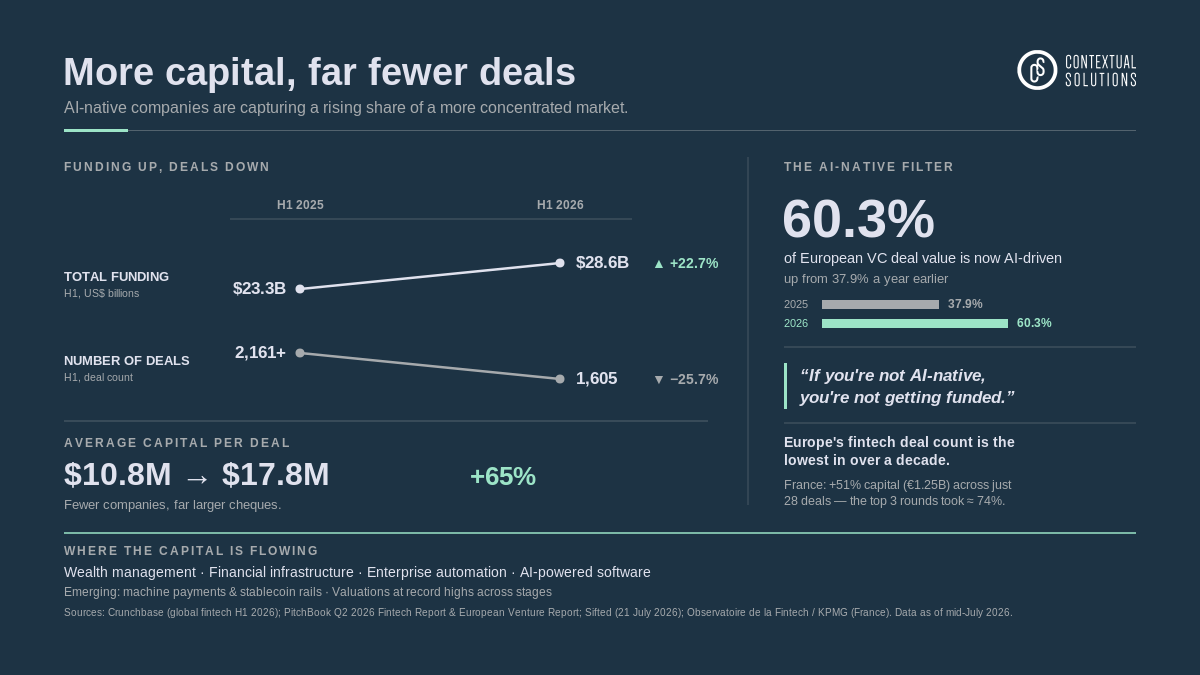
Something structural is happening to the capital that flows into European finance technology. The first half of 2026 delivered the sector's lowest deal count in more than a decade, even as the money committed to fintech worldwide climbed higher. Fewer companies are being funded, and those that clear the bar are raising far larger sums. This is not the familiar rhythm of a cyclical trough waiting to reverse. It is the sound of an industry sorting itself into a smaller set of higher-conviction bets, with artificial intelligence acting as both the underlying technology and the filter that decides who belongs.
The pattern shows up first in the aggregate figures. Fintech startups raised $28.6 billion globally in the first half of 2026, a rise of nearly 23 percent on the same period a year earlier. Yet the number of announced deals fell 25.7 percent to 1,605, down from more than 2,161. The average commitment per transaction rose to roughly $17.8 million, well above the $10.8 million of a year before. Capital, in other words, is pooling. It gathers around companies that already have scale, institutional customers, proprietary data, or a role in the plumbing of financial services.
The numbers behind the narrowing
PitchBook's reading of the quarter tells the same story from a different angle. Its Q2 2026 fintech report put deal value at $13.3 billion, a double-digit gain both year on year and on the previous quarter, while transaction count slipped again to 461. Valuations reached record levels at every stage of the venture lifecycle, with the median pre-money valuation standing at $57.6 million, close to double the 2025 figure. The report singled out three themes drawing the bulk of investor attention: machine-to-machine payments moving from concept to investable infrastructure, stablecoins gaining institutional legitimacy as transaction volumes cleared trillions in the quarter, and AI-powered financial software in heavy demand across accounting, billing, and cross-border rails.
The concentration is even starker when fintech is set against the wider European venture market. Continental startups raised roughly €44 billion in the first half, on track for about 27 percent growth over 2025, but the share going to pure artificial intelligence jumped to 60.3 percent of deal value from 37.9 percent a year earlier. Mega-rounds worth more than €100 million accounted for over half of all capital deployed. Against that backdrop, fintech is competing for a narrowing pool of conviction, and investors are reserving it for the deepest technology bets rather than spreading it across the field.
If you're not AI-native, you're not getting funded.
Sifted analysis of European fintech's H1 2026 funding figures, 21 July 2026
A two-speed continent
National data make the sorting tangible. In France, fintechs raised €1.25 billion in the first half, a 51 percent jump on the year, yet across only 28 rounds, the lowest tally in roughly a decade. Three deals, health insurer Alan, accounting platform Pennylane, and DeFi lending protocol Morpho, absorbed close to three-quarters of the total. Average ticket sizes rose sharply as the number of financed companies shrank. Germany followed a similar shape, rebounding to around €1.2 billion to sit second in Europe behind a United Kingdom that drew €1.9 billion, but with the same selectivity governing which names actually closed a round.
The through-line across these markets is a rising median round size sitting on top of a falling deal count. Growth capital is available for the companies investors already believe in, while the broad middle of the sector, the undifferentiated payments wrappers and consumer apps of the last cycle, finds the primary market largely shut. That squeeze is pushing more founders toward secondary share sales and debt facilities to bridge the gap, a shift that quietly reshapes how liquidity and talent retention work across the continent.
The AI-native filter
What separates the funded from the frozen is increasingly a question of architecture rather than sector. Investors now draw a firm line between products that are AI-enabled, meaning legacy systems with models bolted on, and those that are AI-native, built from the ground up around models, data feedback loops, and agentic workflows. The former is being discounted. The latter commands the premium valuations that pushed medians to record highs. Elena Sakach, an investment partner at GV, captured why financial services has become such fertile ground for this generation of software.
Coding was AI's first killer use case; financial markets could be the second, given its extraordinarily broad corpus of data.
Elena Sakach, Partner, GV (Google Ventures)
That conviction is steering capital toward wealth management, money movement, chargeback reduction, and the infrastructure beneath autonomous financial agents. It also explains why the cheques are getting bigger: building genuinely AI-native systems demands more upfront capital, deeper data access, and longer runways than the lightweight consumer plays that defined the 2021 boom. Investors are paying for depth, and they are paying for it in fewer places.
Regulation as accelerant
Europe's regulatory intensity is amplifying the divide rather than softening it. With the Markets in Crypto-Assets regime fully in force for crypto-asset service providers from 1 July 2026, and PSD3, the AI Act, and the Digital Operational Resilience Act layered on top, the cost of competing without genuine differentiation has climbed steeply. Compliance now favours better-capitalised, more sophisticated operators that can absorb the burden and turn it into a moat. For new entrants, the bar to reach viable scale has risen; for established European platforms, regulatory fluency is becoming a competitive asset in its own right.
The strategic consequences are already visible. Banks and insurers face a choice between acquiring AI-native capability and watching margins compress in wealth, lending, fraud, and back-office operations. Expect consolidation to accelerate as the broad middle is bought, folded, or wound down, and expect incumbent partnerships to move from shallow distribution deals toward deeper, infrastructure-level integration. Nigel Morris of QED Investors, reflecting on four decades in the sector, framed the stakes in terms that leave little room for incrementalism.
This time is different: AI is unlike any wave I have seen in forty years of financial services.
Nigel Morris, Co-Founder and Managing Partner, QED Investors
For European executives, the practical reading is unambiguous. The sector is moving from a phase of high-volume experimentation into one built on infrastructure and conviction. The winners will combine regulatory readiness, proprietary data loops, and authentic AI-native design, and they will do so with leaner teams and larger balance sheets. The risk for the continent is a two-speed market: strong local champions in regulated niches such as payments, open banking, and regtech, but few global category leaders unless AI-native depth improves quickly. The capital is still there. It has simply decided to back far fewer horses.