
On Public Rails
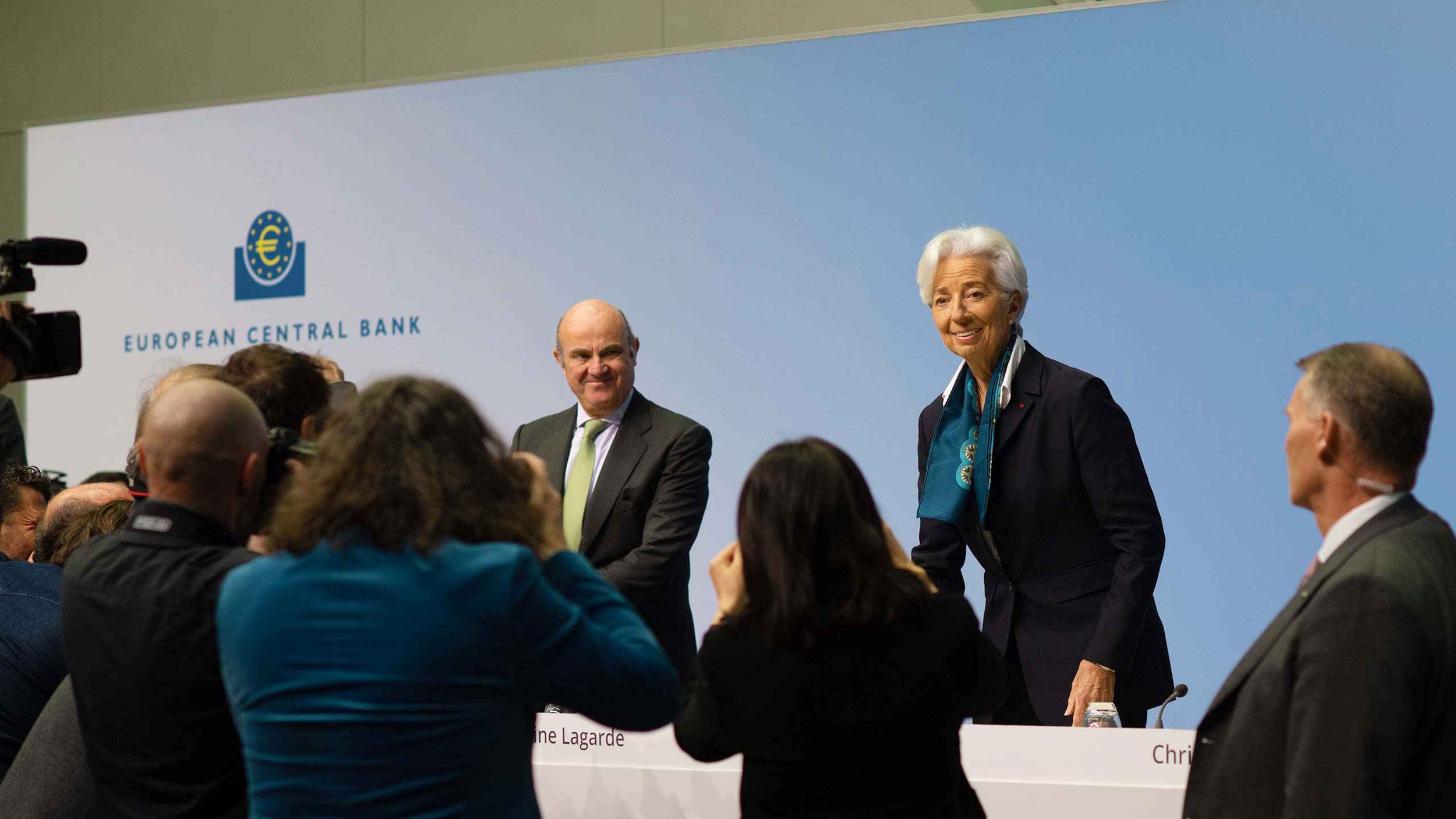
Christine Lagarde wants tokenised finance built on central bank money. For now, the market seems to agree.
Eight centuries ago, Lagarde reminded her audience, the fairs of Champagne were where a divided Europe settled its accounts as one. Merchants from the cloth towns of Flanders and the banking houses of Italy timed their bills to fall due at the same gatherings, clearing vast sums against each other on paper rather than hauling silver across the continent. Then the tolls rose, the sea routes shifted, and Europe's first common market faded. The lesson the European Central Bank's president drew from that history, in a keynote to an ECB conference in Frankfurt on 15 June, was not nostalgic but cautionary: integrated settlement is hard won and easily lost, and a new technology is now testing it again.
That technology is tokenisation, the recording of bonds, equities, funds or deposits as entries on a shared ledger so that ownership and payment can change hands in a single step. Its promise is real, and so is the risk that it deepens, rather than dissolves, the fragmentation that has held European capital markets back. Lagarde's message was that the outcome depends less on the ledgers themselves than on what sits beneath them.
Why tokens need an anchor
The case for tokenisation in Europe begins with a structural embarrassment. A single cross-border securities transaction still passes through a chain of separate record-keepers, each maintaining its own ledger, which drives up costs and entrenches home bias. The Union has 32 central securities depositories performing this work. The United States has two. Decades of effort to weave the national systems together have produced only partial integration, which is what makes a clean-sheet approach attractive. A tokenised layer could, in principle, be complete from the start.
The complication is settlement. A trade is only as safe as the asset used to extinguish it, and Lagarde was blunt about what happens when that asset is not credible.
But the technology settles nothing on its own. Without a credible, risk-free asset to settle in, tokenised finance will splinter into private islands and fail to reach escape velocity from its current sandbox status.
— Christine Lagarde, President of the European Central Bank
This is where private stablecoins enter the argument, and where the ECB's position has hardened. A token backed euro-for-euro, in Lagarde's framing, cannot expand and contract with the market's needs, and so cannot guarantee that liquidity is present when the system most needs it. Only central bank money is trusted and accepted by all participants without question. That view extends the scepticism she set out in a May speech in Madrid, where she questioned the case for euro-denominated stablecoins on grounds of monetary sovereignty, the singleness of money and the danger of runs in periods of stress. The global stablecoin market remains overwhelmingly dollar-denominated, which sharpens the sovereignty concern: left to private rails, a tokenised European market could end up settling in someone else's money.
The strongest part of Lagarde's argument was not theoretical but empirical. The Eurosystem did not assume what the market wanted; it asked.
We brought together more than 60 participants from across the industry, and their message was clear: they will not commit to issuing digital assets at scale until they can settle in central bank money.
— Christine Lagarde, President of the European Central Bank
That claim is consistent with the Eurosystem's exploratory work in 2024, which brought together 64 participants across central banks, market firms and platform operators in more than 50 trials and experiments. The institutional appetite is there. What it has been waiting for is a safe place to settle.
Pontes and Appia
The answer takes the form of two projects, formalised in a dual-track strategy approved by the Governing Council in July 2025. The near-term track is Pontes, a Eurosystem solution that links market DLT platforms to TARGET Services so that the cash leg of a tokenised transaction settles in central bank money. It uses a dual model: participants can settle on the Eurosystem's DLT platform with cash tokens, or directly in T2, the real-time gross settlement system, where finality and legal certainty are assured. A Hash-Link protocol synchronises delivery-versus-payment and other all-or-none transactions across platforms. Its initial launch is planned for the third quarter of 2026, beginning with limited operating hours, with an enhanced version expected to reach round-the-clock functionality by 2028, according to Ledger Insights.
The longer-term track is Appia, the strategic design effort whose roadmap was published in March. Where Pontes is a bridge, Appia is the destination: a blueprint, targeted for 2028, for an integrated and resilient tokenised wholesale ecosystem, developed jointly with the market and exploring more deeply integrated forms of tokenised central bank money. Lagarde set the two in sequence.
The structure matters because it defines the role the public sector intends to play. The ECB is not proposing to build the products. It is proposing to build the rails, and to keep central bank money at their base, while private firms innovate above. That is a deliberate inversion of the stablecoin model, in which private issuers supply both the rail and the settlement asset.
A wider strategy, not a single project
The tokenisation push is one of three fronts in a broader Eurosystem payments strategy. The second is retail, where the digital euro is meant to preserve a public form of money as cash recedes and to break Europe's dependence on foreign card networks. International schemes account for more than 60 percent of card payments in the euro area, and 13 of its 21 countries have no national card scheme of their own. The third is cross-border payments, where the ECB is interlinking its instant system, TIPS, with networks abroad, including a connection now being built to India's UPI. The same logic runs through all three: sovereign infrastructure, open standards, and central bank money as the anchor.
The catch
The vision is coherent. Its delivery is not guaranteed. Much of the hard work lies outside the technology, in the legal certainty of tokenised assets across jurisdictions, in custody, tax and accounting standards, and in achieving enough adoption to reach critical mass. Lagarde acknowledged the dependency directly, calling on governments to provide a common framework for digital assets before national regimes multiply and rebuild in law the fragmentation that technology is dissolving. The industry has been pressing the same point: thirty-nine of Europe's largest financial firms recently signed a joint call for urgent fixes to the EU's DLT Pilot Regime, a sign that the market does not intend to wait quietly for the legal scaffolding to catch up with the technology.
There is also a question of pace. The Eurosystem's method is deliberate and consultative, while private and non-European initiatives can move faster in the interim. The risk is not that the destination is wrong but that the journey is slow enough for habits to form elsewhere first. Champagne, after all, did not lose its fairs to a better idea. It lost them to changing routes and the steady drift of merchants towards somewhere more convenient.
For now, the direction is set, and the closing image was characteristically Lagarde.
What we have built since then, a single currency settled on shared rails, is extraordinary. The challenge is to carry it into the tokenised age, so that the new technology extends our single settlement rather than fragmenting it. This time, we can keep it.
— Christine Lagarde, President of the European Central Bank
Whether Europe keeps it will depend on execution, legislation and the willingness of the market to build where the ECB is laying track. The architecture, at least, is now on the table.