
European Fintech Fundraising & VC: 2025-2026
The "Fintech Winter" that descended in 2022 was an ice-bath for the industry; and a necessary wake-up call.
The exuberance of the zero-interest-rate era (characterized by "growth at any cost" and a scattergun approach to venture capital) has been replaced a mature (and perhaps now too conservative) attitude to funding innovation. The last year has made it clear that there will be no rapid recovery; the industry has instead chosen to focus more on profitability, strategic consolidation, and technologies that actually move the needle on outcomes.
As we look toward 2026, the data paints a picture of a sector that is leaner, more concentrated, and surprisingly resilient.
A Tale of Two Markets
If 2024 was defined by scarcity, 2025 was defined by bifurcation. The recovery in fundraising has been robust, with year-to-date figures reaching approximately €6.3 billion by September, surpassing 70% of 2024’s total. However, the distribution of that capital has been uneven.
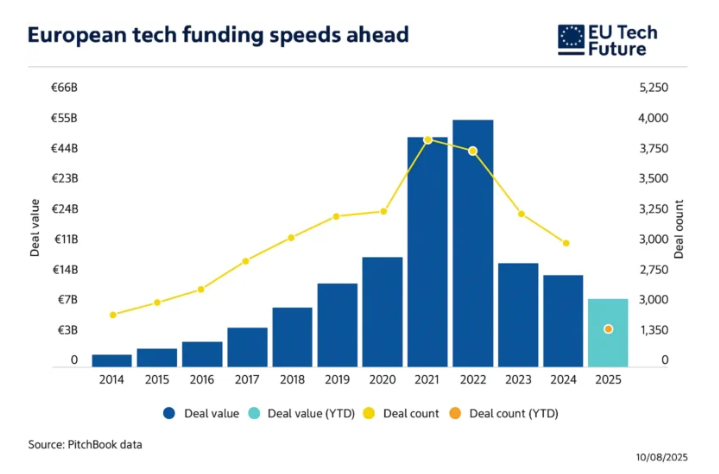
We are witnessing a "barbell" market structure. On one end, we have the "Series A Crunch," where early-stage deal volumes have contracted as investors demand almost unreasonable traction metrics before writing a check. The days of raising €10 million on a slide deck are over.
On the other end, we see a flight to quality driving massive inflows into late-stage winners. In the UK alone, late-stage funding rose by 42% in the first nine months of 2025. Investors are not taking risks on new models; they are doubling down on proven ones. This is best exemplified by Revolut, which cemented its status as Europe’s most valuable private tech company with a $75 billion valuation following a secondary share sale.
Crucially, the mechanism of funding has changed. Klarna’s massive $1.63 billion raise in August wasn't a dilutive equity round, but a structured debt facility. This signals a sophistication in the market: mature fintechs are now utilizing their balance sheets and loan books to fund growth, minimizing equity dilution ahead of anticipated IPOs.
The Great Rebundling
The era of "unbundling the bank"—where every specific function had its own standalone app—is officially dead. 2025 has been the year of rebundling, driven by a wave of consolidation that is reshaping the competitive map.
Three transactions in 2025 tell the whole story of this trend:
The Infrastructure Play: Global Payments’ $24.25 billion acquisition of Worldpay is a transatlantic titan, creating a payment processing behemoth capable of serving enterprise merchants globally. This isn't just M&A; it's an arms race for scale in a volume-based business.
The Pan-European Champion: In a move that surprised many, Dutch unicorn Mollie acquired UK-based GoCardless in a €1.05 billion deal. This merger combines Mollie’s strength in card acquiring with GoCardless’s dominance in recurring payments (Direct Debit), creating a full-stack payments giant ready to challenge Stripe and Adyen on European soil.
The Incumbent Strike: Lloyds Banking Group’s acquisition of the digital wallet Curve for roughly £120 million represents the final stage of the fintech cycle: incumbent capitulation turned into strategic absorption. Rather than competing with the "over-the-top" wallet, Lloyds bought the technology to integrate it, signaling that traditional banks are now confident enough to buy innovation at distressed prices (Curve had previously raised over £250m).
For executives, the takeaway is clear: the mid-market is thinning out. You either scale up to become a platform, or you get acquired by one.
The Rise of "Sovereign Fintechs"
While London remains the undisputed capital—attracting 90% of UK funding —2025 saw the rise of what we might call "Sovereign Fintechs." These are national champions emerging in markets on Europe’s periphery, solving deep, local friction points that global generalists overlook.
Two standout examples from 2025 illustrate this:
Midas (Turkey): Raised an $80 million Series B (the largest in the country's history) to give Turkish citizens access to US equity markets. In a high-inflation environment, providing access to stable assets is not just a feature; it's a lifeline.
Uzum (Uzbekistan): Became a unicorn with a $70 million raise. Uzum is building a "SuperApp" ecosystem (combining e-commerce, banking, and payments) in a market with low banking penetration.
These companies prove that while Western European markets are saturated, massive "blue ocean" opportunities remain in regions where fintech is essential infrastructure rather than just a convenience.
From Generative to Agentic
For the past two years, boardrooms have been buzzing with "Generative AI." In 2025, the conversation shifted to "Agentic AI."
The distinction is critical. Generative AI creates content (emails, code, images). Agentic AI executes actions. It is the difference between a chatbot that tells you how to cancel a subscription and an AI agent that logs in, navigates the menu, and cancels it for you.
Banks and fintechs are deploying these agents to automate the "boring" middle and back-office functions that have historically been cost centers.
Operational Efficiency: We are seeing AI agents handle end-to-end loan underwriting, reducing cycle times from days to hours.
The Customer Interface: Revolut is heavily investing in AI assistants that actively manage user finances, blurring the line between a bank account and a financial advisor.
For 2026, the metric for AI success will not be "adoption" but "autonomy"—how many human processes have been fully handed over to agentic workflows?
Outlook 2026: The IPO Dam Breaks?
As we look to 2026, the pressure in the system is palpable. Europe has a backlog of over 22 fintech unicorns valued above $2 billion , all waiting for the right window to list.
The Klarna and Revolut IPOs are the "main events" that will define the market sentiment for the latter half of the decade. If they list successfully—and crucially, if they choose European exchanges (though the US seems likely for Klarna)—it could trigger a cascade of liquidity events for the rest of the backlog.
Furthermore, the regulatory environment is shifting from a headwind to a tailwind. With MiCA (Markets in Crypto-Assets) fully live, we expect 2026 to be the year of Stablecoin Rails. Major European banks are already piloting Euro-denominated stablecoins. The "wild west" of crypto is over; the institutionalization of digital assets is here, and it will likely become the standard for cross-border B2B payments.
The Capital Bifurcation
The data from 2025 reveals a distinct separation in the venture market. While overall funding has stabilized—with late-stage deal value in the UK jumping 42% —the recovery is uneven. We have entered a "barbell" market:
At the top: Capital is concentrating in "category kings." Investors are aggressively funding pre-IPO giants like Revolut and Klarna to clean up cap tables and fund M&A, effectively treating them as safe-haven assets.
At the bottom: The "Series A Crunch" persists. The bar for early-stage funding has risen permanently; founders now need to demonstrate the kind of unit economics at Series A that were previously expected at Series C.
The AI Anomaly: Crucially, even the hottest sector is facing scrutiny. Data from Q3 2025 shows that while the broader market stabilized, AI startups saw an increase in down rounds (hitting 15%), making it the only major sector to perform worse than the market average. This signals that the "AI premium" is evaporating; investors are no longer writing blank checks for buzzwords without execution.
The Liquidity Pressure Cooker Heading into 2026, the primary tension in the market is the massive backlog of exits. Europe now holds over 22 fintech unicorns valued above $2 billion, trapping a combined valuation of $150 billion. Venture funds, facing pressure to return capital to Limited Partners (LPs), can no longer wait.
The IPO Dam: 2026 will likely be the year the IPO dam finally breaks. If windows remain tight, we expect a surge in "continuation funds" (where VCs sell assets to themselves to reset timelines) and secondary market sales, as seen with Revolut’s $75 billion valuation update.
Forced Consolidation: For the "middle class" of fintechs—good companies that aren't quite unicorns—the exit path in 2026 will likely be M&A. Incumbents and platform giants will continue to acquire infrastructure providers (like the Lloyds/Curve and Mollie/GoCardless deals) to solve their own tech debt instantly.
The direction for 2026 is clear: Infrastructure over Interfaces. The next wave of capital will not flow to new neobanks or consumer apps, but to the "rails" that make finance autonomous. Expect VC allocation to pivot heavily toward Agentic AI workflows that reduce headcount, and stablecoin infrastructure that solves cross-border friction under the safety of MiCA regulation.
In short, the "Fintech Tourist" era is over. 2026 belongs to the infrastructure builders and the profit generators.