
The $60 Loaf of Bread: What Consumer Behaviour Reveals About Pricing, Market Positioning and Go-to-Market Strategy
Why are consumers willing to pay extraordinary prices for everyday products while becoming increasingly selective about their spending? The answer lies in changing perceptions of value, emotional consumption, and the importance of local market context. A premium bakery in New York offers an interesting case study for businesses developing their go-to-market strategies.

Image: Mara Hohla, die Presse
When an everyday product becomes a luxury
Would you pay $60 for a loaf of bread?
At RYE by Martin Auer, an Austrian bakery in New York, a loaf of rye bread has attracted considerable attention for precisely that price. The product has become a subject of media coverage and social media discussion, attracting consumers interested in experiencing an unusually expensive version of an everyday staple.
From a conventional pricing perspective, the proposition appears difficult to justify. Bread is a widely available product, and consumers can purchase high-quality alternatives for a fraction of the price. Yet the attention surrounding RYE illustrates an important principle of contemporary consumer behaviour: the value of a product is not determined exclusively by its functional utility.
A loaf of bread provides nourishment. A $60 loaf purchased from a fashionable New York bakery may also offer an experience, a story, a sense of exclusivity and an opportunity to participate in a cultural moment.
These additional dimensions influence how consumers perceive value and, consequently, how much they are willing to pay.
The case is particularly interesting in the context of changing consumer spending patterns. Across Europe and the United States, economic uncertainty continues to influence purchasing decisions. Consumers are becoming more selective about where they spend their money, but that does not necessarily mean they are abandoning discretionary purchases.
Instead, they may be reallocating spending towards products and experiences that deliver a greater perceived emotional or personal benefit.
For companies developing new products or entering unfamiliar markets, this creates both opportunities and challenges. Understanding the functional characteristics of a product is no longer sufficient. Businesses must also understand the cultural, emotional and social factors that influence purchasing decisions in their target markets.
The lipstick effect: Why consumers save and splurge at the same time
The economic environment provides important context for understanding the popularity of premium everyday products.
When consumers face inflation, economic uncertainty or concerns about their financial security, they often reconsider major purchases. Expensive holidays, furniture, electronics and other discretionary expenditures may be postponed or reduced.
However, financial caution does not necessarily eliminate the desire for enjoyment, self-expression or occasional indulgence.
This behaviour is commonly associated with the lipstick effect, a consumer behaviour hypothesis suggesting that people may continue purchasing relatively affordable luxuries during periods of economic uncertainty, even while reducing spending on larger purchases.
The original concept is associated with beauty products, particularly premium lipstick. A consumer who cannot justify purchasing an expensive handbag may still be willing to spend more than usual on a cosmetic product that provides a sense of luxury at a manageable absolute cost.
Today, the principle extends well beyond cosmetics.
Premium coffee, specialty matcha, limited-edition confectionery, collectible toys and artisanal food products can all serve a similar purpose. They allow consumers to enjoy a small, personally meaningful purchase without committing to a substantially larger expenditure.
Importantly, the lipstick effect is not a universal economic law. Consumer responses to financial uncertainty vary according to income, age, cultural context and the perceived value of particular products.
Nevertheless, recent consumer research indicates that financial restraint and selective indulgence can coexist.
What 2026 consumer research tells us
McKinsey's March 2026 European consumer sentiment research provides an interesting perspective on this apparent contradiction.
According to its German consumer survey, only 21% of respondents were optimistic about the economic outlook in the first quarter of 2026. Inflation and economic uncertainty remained major concerns, with 40% identifying them as significant challenges.
At the same time, consumers were not reducing expenditure equally across all categories.
While 40% of German respondents intended to spend less on furniture and accessories, 32% indicated that treating themselves was a motivation for spending on travel.
The generational differences were particularly pronounced. Among German respondents, 56% of Gen Z planned to treat themselves, compared with 39% of millennials, 28% of Gen X and 21% of baby boomers.
GERMAN CONSUMER SENTIMENT · Q1 2026
Who plans to treat themselves?
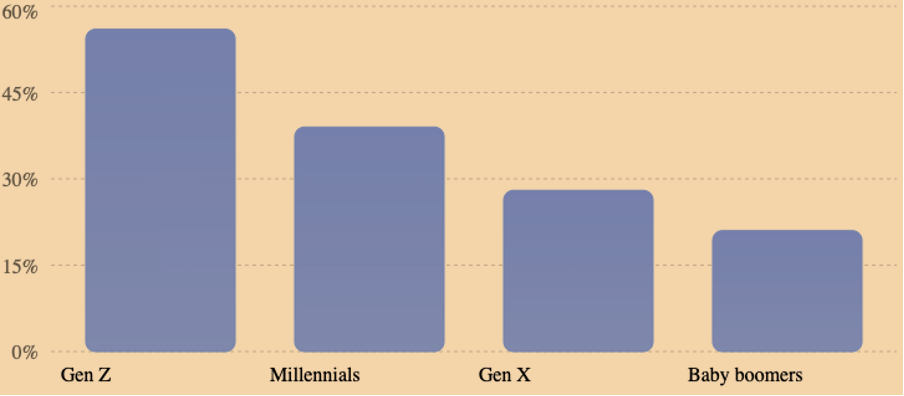
Source: McKinsey, German consumer sentiment survey, March 2026. Figures represent stated intentions, not actual expenditure.
The findings suggest that economic uncertainty does not necessarily suppress the desire for discretionary consumption. Instead, consumers may become more selective about the products and experiences on which they are willing to spend.
McKinsey's research on US consumer sentiment provides further evidence of this pattern.
In its December 2025 report, 75% of US consumers reported trading down in at least one product category, while 39% still intended to splurge in selected categories.
McKinsey describes this as an extension of the lipstick effect beyond the traditional beauty market, with consumers continuing to prioritise certain affordable indulgences despite financial pressures.
The commercial implication is significant. Consumers cannot be divided neatly into two groups: those who are price-sensitive and those who are willing to pay a premium.
The same customer may purchase discounted groceries, postpone buying a new smartphone and spend considerably more than usual on a particular dining experience.
For businesses, understanding these spending priorities is more valuable than relying exclusively on broad demographic assumptions or average purchasing power.
Gen Z and the changing definition of value
Generational differences add another dimension to the discussion.
Gen Z is often characterised as a digitally connected, experience-oriented generation. However, its purchasing behaviour is more nuanced than the assumption that younger consumers simply prioritise experiences over material possessions.
McKinsey's October 2025 ConsumerWise analysis, based on research involving more than 25,000 consumers across 18 countries, found that younger consumers place considerable importance on financial security while remaining willing to spend on products and experiences that matter to them.
Across the surveyed countries, an average of 65% of Gen Z respondents expressed a willingness to splurge in selected categories.
The research also highlighted the growing importance of smaller experiences, including premium coffee and nutrition-related purchases, in younger consumers' spending decisions.
This creates an interesting dynamic for brands.
Traditional value propositions often focus on the functional benefits of a product, such as quality, durability, convenience or price.
For some consumers, particularly in categories associated with lifestyle and self-expression, the perceived value of a purchase may also include its emotional and social dimensions.
A premium bakery, for example, may offer excellent bread, but the overall experience can include the atmosphere of the store, the story behind its products, its reputation and the opportunity to discover something distinctive.
The product becomes part of a broader experience rather than an isolated purchase.
From product ownership to social currency
Social media has further changed how consumers discover and evaluate products.
A distinctive purchase can become a form of social currency when it provides something interesting to share, discuss or experience with others.
This is particularly relevant for products that attract attention because of their unusual characteristics, limited availability or association with a specific cultural moment.
The popularity of Dubai Chocolate and collectible Labubu figures illustrates how products can gain visibility through a combination of distinctive positioning, social media exposure and consumer participation.
The $60 loaf of bread follows a comparable pattern, although its long-term commercial potential remains to be seen.
Consumers may be motivated by the product's quality, but some may also be interested in experiencing the bakery themselves, understanding why its bread commands such a high price or participating in the wider discussion.
For brands, this creates an opportunity to build value beyond functional product attributes.
However, social visibility and sustainable demand are not the same thing.
A product may attract substantial attention during its launch without generating sufficient repeat purchases to support a profitable business.
The commercial challenge is to translate initial curiosity into lasting customer relationships.
The $60 bread: A lesson in premium (product) positioning
RYE by Martin Auer offers an interesting example of how market context influences the perception of a product.
The bakery's New York location sells a large rye sourdough loaf for $60. Its pricing has attracted attention, particularly because a comparable loaf is sold for substantially less in Austria.
The bakery attributes the US price to factors including imported Austrian ingredients, its production methods and the costs of operating in New York.
These factors provide a potential explanation for the price, but they do not automatically establish whether consumers consider it reasonable.
That depends on the competitive environment and the value customers associate with the product.
In New York, traditional Austrian rye bread may represent a distinctive culinary experience. Its origin, craftsmanship and relative scarcity can contribute to its positioning.
The product is not necessarily competing only with other loaves of bread. For some customers, it may also compete with other premium food experiences.
This distinction is central to premium pricing.
A product's price is influenced not only by its production costs or intrinsic quality, but also by the alternatives available to consumers and the benefits they believe the product provides.
For RYE, the combination of Austrian baking heritage, imported ingredients, artisanal production and a distinctive retail experience creates a potential basis for differentiation.
The question is whether that differentiation is sufficiently meaningful to the target audience to justify the price.
Product lesson: premium pricing requires more than an expensive product
A high price can contribute to a product's positioning, but it cannot create a sustainable premium brand on its own.
Consumers need a reason to believe that the product offers something they cannot easily obtain elsewhere.
That reason may involve exceptional quality, craftsmanship, scarcity, provenance, convenience or a distinctive experience.
In some categories, brand reputation and social recognition also influence purchasing decisions.
However, the relative importance of these factors varies considerably between markets.
A premium product that benefits from scarcity in one country may face extensive competition in another.
Similarly, a brand that successfully uses exclusivity to justify its pricing in one market may encounter resistance where consumers expect premium quality to be widely accessible.
This is where international go-to-market strategy becomes particularly important.
The challenge is not simply to identify customers who can afford the product. It is to identify customers who perceive sufficient value in the specific proposition being offered.
Would the same positioning work in Germany?
Germany provides an interesting counterexample to the New York market.
Bread occupies a distinctive position in German food culture. Consumers have access to a broad variety of regional bread types, traditional bakeries and increasingly sophisticated artisanal baking concepts.
Premium bakeries such as Zeit für Brot and SOFI in Berlin demonstrate that consumers are willing to pay more for products associated with craftsmanship, quality and a distinctive retail experience.
However, the competitive environment differs substantially from New York.
In Germany, high-quality rye and sourdough bread are familiar products rather than unusual culinary discoveries. A bakery entering the market with a premium rye loaf would compete with established local providers whose products may already meet the expectations of its target customers.
The price comparison is revealing.
Zeit für Brot's Hausbrot has been reported at approximately €9–10 per kilogram, considerably below the price per kilogram of RYE's New York offering.

Berlin’s popular bakery Zeit fuer Brot quickly became a chain store. Image from the Prenzlauer Berg branch.
This does not mean that German consumers would categorically reject a €60 loaf of bread.
A small customer segment may be willing to pay that amount for a distinctive product, particularly when the purchase is associated with an exceptional experience or a special occasion.
However, the proposition would need to compete against a different set of alternatives and consumer expectations.
The important question is therefore not whether Germans are willing to purchase luxury products.
It is whether the particular product offers enough additional value compared with the alternatives already available in the German market.
Local market context changes the value proposition
A product's origin can be an important element of its positioning, but its significance changes across markets.
Austrian rye bread may represent a distinctive European culinary tradition in New York. In Germany, where comparable bread varieties are already familiar, the same origin story may have less differentiating power.
The product itself has not changed, but the competitive context has.
This illustrates a fundamental principle of international market entry: a value proposition is not universally transferable.
Businesses must understand how their products are perceived relative to local alternatives, which attributes customers consider exceptional and how much they are willing to pay for those attributes.
For a premium bakery entering Germany, this might mean emphasising a distinctive production method, a particular regional tradition or an exceptional in-store experience rather than relying primarily on the novelty of European artisanal bread.
The same principle applies to technology, financial services and other industries.
A FinTech company offering a payment solution that is considered innovative in its home market may discover that comparable functionality is already standard in Germany.
A technology provider entering a new market may need to reposition its product around different customer problems, integration requirements or service expectations.
Market entry requires more than translating marketing materials and adapting prices. It requires validating the relevance of the underlying value proposition.
Lidl's response: How to turn a competitor's publicity into a marketing opportunity
The RYE case also provides an interesting example of reactive marketing. As the $60 bread attracted attention, Lidl used the discussion to reinforce its own price positioning in the US market.
The retailer placed a digital advertising truck near the New York bakery, contrasting the premium bread price with its own substantially cheaper alternatives.
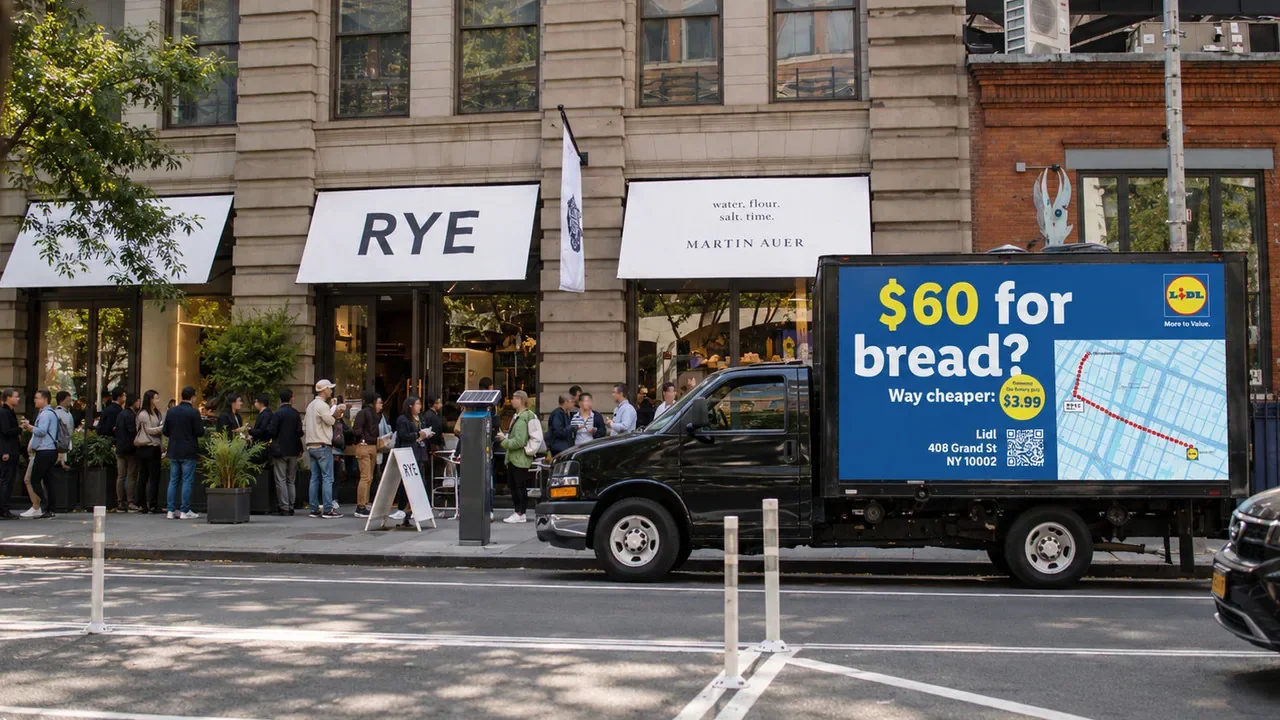
Source: LIDL
The campaign included a comparison with Lidl's $3.99 bread offering and directed consumers towards a nearby store. Additional promotional material contrasted the $60 price with the number of inexpensive croissants consumers could purchase for the same amount.
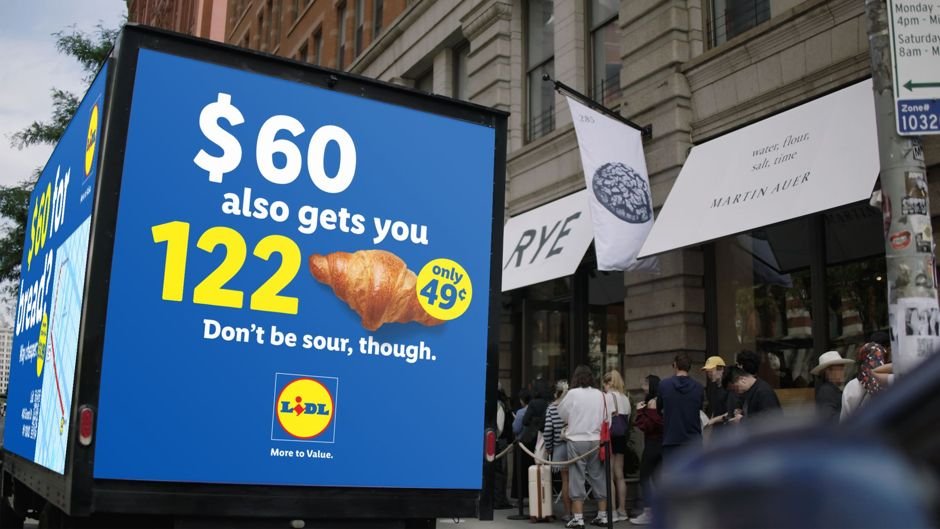
Source: LIDL
The campaign is an example of how a brand can use an existing public conversation to communicate its own value proposition.
RYE's publicity created awareness of an unusually expensive everyday product. Lidl entered the discussion with a contrasting message: consumers can purchase bread at a substantially lower price.
The approach is effective from a positioning perspective because the two brands represent different consumer priorities.
RYE emphasises craftsmanship, exclusivity and a distinctive experience. Lidl emphasises accessibility and value for money.
Rather than attempting to imitate the premium proposition, Lidl used the comparison to reinforce its established brand positioning.
The campaign also illustrates several marketing trends that are becoming increasingly relevant for businesses operating in competitive markets.
Lessons learned
1. Cultural relevance can be more valuable than a large advertising budget
Traditional marketing campaigns often require extensive planning, production and media investment.
Reactive marketing takes a different approach by identifying an existing public conversation and contributing a message that is relevant to the brand.
The $60 bread had already attracted media attention and social media discussion. Lidl did not need to introduce the subject or explain why it was interesting.
Instead, the company connected the existing conversation to its own commercial proposition.
This approach can be particularly useful for challenger brands and companies entering new markets, where establishing awareness through conventional advertising may be expensive.
However, successful reactive marketing requires more than responding quickly to a trending topic.
The connection between the trend and the brand must be credible. A campaign that attracts attention but has little relevance to the company's products or positioning may generate visibility without meaningful commercial benefits.
In Lidl's case, the connection was direct: the public discussion concerned the price of bread, while the retailer's established proposition centres on affordable everyday products.
2. Contrast makes a value proposition easier to understand
Consumers rarely evaluate products in isolation.
They compare prices, features, quality and perceived benefits against available alternatives.
Lidl's campaign used this principle by presenting two very different pricing propositions within the same product category.
The comparison made the retailer's affordability message immediately understandable.
However, it is important to distinguish between a compelling advertising comparison and a complete assessment of product value.
The two products differ in ingredients, production methods, size and positioning. A lower price does not necessarily mean that consumers receive an equivalent product.
The campaign works because Lidl is communicating affordability rather than claiming to reproduce RYE's entire product experience.
For businesses developing go-to-market strategies, this distinction is important.
A challenger brand does not necessarily need to demonstrate superiority across every product attribute.
It needs to identify the dimensions on which it can offer a meaningful alternative to its target customers.
3. Social media visibility needs to connect to commercial objectives
Lidl's campaign also demonstrates how online attention can be connected to physical retail activity.
The advertising directed consumers towards a nearby Lidl store, creating a potential link between brand awareness and customer acquisition.
This is particularly relevant in an environment where social media increasingly influences product discovery and purchasing decisions.
McKinsey's 2026 State of the Consumer research found that 23% of Gen Z respondents discovered new brands through social media, compared with 7% of baby boomers.
Social media also played an important role during the purchasing stage for 34% of Gen Z respondents, compared with 16% of baby boomers. However, digital visibility does not automatically translate into trust.
McKinsey's July 2026 analysis highlights that younger consumers increasingly use social media and generative AI for product research while remaining relatively sceptical of these channels as sources of reliable information. For brands, this creates a dual challenge.
Marketing needs to reach consumers through the channels they use to discover products, but the product and customer experience must provide sufficient evidence to justify the purchasing decision.
A successful campaign may encourage a customer to visit a store or website for the first time. Whether that customer returns depends on the value delivered after the initial interaction.
What the $60 bread reveals about modern go-to-market strategy
The contrasting approaches of RYE and Lidl illustrate how different businesses can respond to the same consumer environment with different value propositions.
RYE targets consumers who may be willing to pay a premium for craftsmanship, exclusivity and experience.
Lidl addresses consumers seeking affordable everyday products and uses the premium bread discussion to reinforce its own positioning.
Both propositions can coexist because consumers do not make every purchasing decision according to the same criteria.
A customer who purchases an expensive artisanal product on a special occasion may still buy everyday groceries from a discount retailer.
For companies entering new markets, the challenge is to identify which purchasing motivations are relevant to their target customers and develop a go-to-market strategy around them.
Understanding the local value equation
McKinsey's State of the Consumer research identifies changing perceptions of value as an important factor shaping purchasing behaviour. Its 2025 analysis found that 47% of surveyed consumers globally considered buying domestic brands important, with the figure reaching 52% across the five major European markets examined.
The research also highlighted that consumers increasingly evaluate products according to a combination of price, quality, convenience and personal relevance. These findings have implications for international expansion.
A company may possess a strong brand and an established customer base in its home market, but those advantages do not necessarily transfer to another country.
Local consumers may have different expectations regarding product quality, pricing, customer service, convenience or brand reputation.
Domestic competitors may also benefit from established relationships and a deeper understanding of local purchasing behaviour.
For a foreign company, the objective should therefore be to understand the local value equation before determining how its product should be positioned.
This requires research into both consumer behaviour and the competitive environment.
What problem does the product solve for customers in the target market? Which alternatives are they currently using? What would motivate them to switch? Which product attributes justify a premium, and which are already considered standard?
These questions should inform product adaptation, pricing, distribution and marketing decisions.
Market segmentation needs to go beyond demographics
The McKinsey findings on Gen Z provide useful insights, but they should not be interpreted as evidence that every young consumer is willing to purchase expensive products.
A generational category contains individuals with different incomes, priorities, lifestyles and purchasing motivations.
The same applies to national markets.
The German market cannot be treated as a homogeneous group of consumers who are either universally price-conscious or universally willing to pay for quality.
Effective segmentation should therefore consider behavioural and motivational differences alongside demographic characteristics.
For a premium food brand, relevant segments might include consumers who prioritise artisanal quality, customers seeking distinctive experiences and buyers who value convenience or accessibility.
For a FinTech company, segmentation might instead focus on financial needs, digital behaviour, trust, willingness to switch providers and dissatisfaction with existing solutions.
The objective is to identify groups of customers who share a meaningful purchasing motivation and develop a proposition that addresses it.
Pricing should be validated locally
One of the most common mistakes in international market entry is assuming that a successful pricing model can be transferred directly to a new market.
Companies may adjust their prices according to exchange rates, local costs or average purchasing power without examining how customers perceive the value of their products.
However, willingness to pay is influenced by the competitive environment and the benefits customers associate with a particular solution.
A premium product may command a higher price in a market where comparable alternatives are scarce.
In a market with established competitors and high-quality substitutes, the same product may require a different pricing strategy or additional differentiation.
For businesses considering international expansion, pricing research should therefore include customer interviews, competitive benchmarking and controlled market tests.
Where appropriate, companies can test different product configurations, package sizes or service levels to determine which combinations of value and price resonate with local customers.
RYE's offering of smaller portions alongside its full-sized loaf illustrates how different purchase formats can make a premium product accessible to customers who may not wish to commit to the full price. Therefore, this case is relevant beyond the food industry.
Technology companies can test different subscription tiers, implementation packages or usage-based pricing models.
Financial service providers can assess how customers respond to different combinations of fees, functionality, and service levels.
The underlying principle remains the same: pricing should reflect the value perceived by the target customer, not simply the company's existing pricing structure.
From product-market fit to market-product fit
Product-market fit is often discussed as a milestone that companies achieve before scaling their businesses.
However, a product that has achieved strong demand in one market does not automatically possess the same fit in another.
International expansion introduces new customer expectations, competitive dynamics, cultural factors and purchasing behaviours.
A product may require changes to its functionality, positioning, pricing or distribution before it can address the needs of the new market effectively.
This makes market validation an essential part of go-to-market planning.
For companies entering Germany, the process should begin with a clear understanding of the local customer problem and the alternatives already available.
Businesses should then evaluate whether their existing proposition offers sufficient differentiation and whether the intended customer segment is willing to pay for it.
The marketing strategy should follow from these findings rather than attempting to generate demand for a proposition that has not been validated.
This approach is particularly important for companies entering mature and highly competitive markets.
An international brand may benefit from an established reputation elsewhere, but local customers still need a compelling reason to choose it over familiar alternatives.
Final words: the product may travel, but its value proposition needs to be local
The $60 loaf of bread is an interesting example of how consumer behaviour, premium positioning and cultural context interact.
Its popularity in New York suggests that some consumers are willing to pay substantial premiums for everyday products when those products offer a distinctive combination of quality, experience and perceived exclusivity.
McKinsey's consumer research provides a broader explanation for this behaviour. Even during periods of economic uncertainty, consumers continue to spend selectively on products and experiences that matter to them.
However, the categories in which consumers are willing to indulge, the prices they consider acceptable and the benefits they associate with premium products vary across markets.
A €60 loaf of bread might attract a niche audience in Germany, but the country's established bread culture and extensive availability of high-quality alternatives create a different competitive environment from New York.
For businesses entering new markets, the lesson extends well beyond premium food products.
A successful go-to-market strategy requires a clear understanding of local consumer behaviour, competitive alternatives, cultural expectations and willingness to pay.
Companies should not assume that a product's established positioning, pricing or marketing strategy will generate the same response in another market.
They need to determine which aspects of their proposition are transferable, which require adaptation and how to communicate their value to the customers they want to reach.
The objective is not simply to introduce a product into a new country.
It is to establish why customers in that market should choose it.
Bonus: Five questions businesses should answer before entering a new market
The $60 bread provides a useful starting point for examining the assumptions behind international expansion.
Before committing significant resources to a new market, businesses should consider five interconnected questions.
1. What makes our product valuable in the target market?
A product's established value proposition may not translate directly into a new cultural or competitive environment. Companies need to understand which attributes local customers consider important and whether those attributes are sufficiently differentiated from existing alternatives.
2. Who is our actual target customer?
Broad demographic categories provide a starting point, but effective segmentation requires an understanding of purchasing motivations, customer needs and willingness to pay. A niche premium product and a mass-market offering may require entirely different approaches, even within the same industry.
3. What are customers comparing us against?
Competitor analysis should extend beyond companies offering technically identical products. Customers may evaluate a purchase against different products, services or experiences that satisfy the same underlying need.
4. How should we adapt our pricing and positioning?
Local costs and purchasing power are relevant, but they do not provide a complete picture of willingness to pay. Pricing should be evaluated in relation to the benefits customers perceive and the alternatives available to them.
5. Which marketing channels can turn awareness into sustainable demand?
Social media, influencer marketing and reactive campaigns can generate visibility, but companies need to determine how that visibility connects to customer acquisition, conversion and retention.
The appropriate channel mix depends on the target audience, product category and local purchasing journey.
A campaign that generates substantial attention may still have limited commercial value if it reaches consumers who are unlikely to purchase the product.
———
Would you like to learn more about effective go-to-market strategies or have your existing strategy assessed?
At Contextual Solutions, we help businesses develop and refine their market-entry strategies, identify growth opportunities and adapt their positioning to local customer expectations.
Contact us at info@contextuals.de to book your free GTM assessment call and explore how we can support your next stage of growth.
FAQs
What does the $60 bread trend reveal about consumer behaviour?
The trend illustrates how consumers may assign value to products beyond their functional utility. Craftsmanship, exclusivity, emotional satisfaction and social recognition can influence purchasing decisions, particularly for premium everyday products.
What is the lipstick effect in marketing?
The lipstick effect describes the tendency of some consumers to continue purchasing relatively affordable luxuries during periods of economic uncertainty, even while reducing spending on larger discretionary purchases. It is a consumer behaviour hypothesis rather than a universal economic rule.
Why is local market positioning important for international expansion?
Consumer expectations, competitive alternatives, cultural preferences and willingness to pay differ across markets. A product that commands a premium in one country may require different positioning or pricing in another. Local market research helps businesses identify which elements of their value proposition need adaptation.
How can businesses adapt their go-to-market strategy for Germany?
Businesses entering Germany should evaluate local customer needs, existing competitors, purchasing behaviour and willingness to pay. These insights should inform product positioning, pricing, distribution, and marketing before significant resources are committed to market expansion. Download our 2026 Fintech and Banking Report to understand the trends impacting the German tech market and economy.
What can businesses learn from Lidl's response to the $60 bread trend?
Lidl's campaign illustrates how brands can use an existing cultural conversation to reinforce their value proposition. By contrasting premium bread pricing with its own affordable products, the retailer connected topical publicity with its established market positioning.